The Field Guide · No. 32
Blinding: why not knowing the treatment protects the result
Blinding keeps participants, caregivers, or the people measuring outcomes from knowing who received which treatment, so belief cannot quietly skew the result.
Updated
Blinding is the practice of keeping someone involved in a trial from knowing which treatment a given participant received. A single-blind trial keeps participants unaware of their own assignment. A double-blind trial extends that to the people delivering the treatment and, often, the people measuring the outcome as well. The point is that knowing which group you are in, or which group a patient is in, can change behavior and judgment even when nobody intends to cheat.
The risk runs in both directions. A participant who knows they are getting the real drug rather than a placebo may report feeling better simply from expecting to, the well documented placebo effect, while a researcher who knows which patients got the real treatment may unconsciously rate their symptoms more favorably or measure them more carefully. Blinding both sides removes belief and expectation as a source of the measured difference between groups.
Two traps follow. First, blinding participants and blinding the people who measure the outcome are separate protections, and a trial can blind one without the other, so a report worth trusting on this point should say clearly who was kept unaware of what. Second, some treatments, such as surgery or a distinctive side effect, are difficult or impossible to blind fully, which does not make the trial worthless but does mean the result deserves more scrutiny of how the outcome was measured.
When reading about a trial's result, check whether it was blinded, and specifically whether the people measuring the outcome, not only the participants, were kept unaware of who received which treatment. An outcome that depends on subjective judgment, such as a pain score or a symptom rating, is far more sensitive to unblinding than an outcome like death or a lab measurement. Pair a trial's headline result with a look at whether its outcome assessment could plausibly have been influenced by knowing the assignment.
What to remember
- Blinding keeps participants, caregivers, or outcome assessors unaware of which treatment a given patient received.
- Both the person receiving a treatment and the person measuring its effect can unconsciously bias a result once they know the assignment.
- Subjective outcomes, such as pain or symptom scores, are more sensitive to a lack of blinding than objective ones like death.
From the record
Bias due to deviations from intended interventions can sometimes be reduced or avoided by implementing mechanisms that ensure the participants, carers and trial personnel are unaware of the interventions received.
Asked often
What is the difference between single-blind and double-blind?
In a single-blind trial, only the participants are kept unaware of which treatment they received. In a double-blind trial, the people delivering the treatment and, often, the people measuring the outcome are kept unaware as well. Double-blind designs guard against bias from both the participant's expectations and the researcher's judgment, which is why they are generally considered stronger.
Why can blinding outcome assessors matter as much as blinding participants?
A researcher who knows which patients received the real treatment can unconsciously measure or interpret their symptoms more favorably, especially for a subjective outcome like a pain or mood rating. Keeping the people who measure the outcome unaware of the assignment, sometimes called masking, protects against this even when the participants themselves cannot be fully blinded.
Further reading
Go deeper
Paid link. If you buy a book through this link, Bookshop.org pays us a small commission and sends a share of the sale to independent bookstores.
-
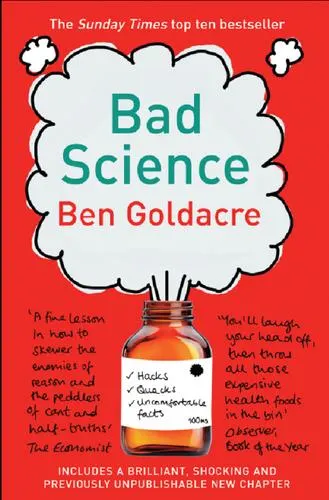
Bad Science (opens Bookshop.org)
Ben Goldacre · 2008
Ben Goldacre, a physician, shows through homeopathy trials and health-column claims why blinded, controlled comparisons are needed before believing that a treatment works.
Read the news better, every morning.
We send you the day's real progress in science, medicine and beyond, told plainly and sourced. Free, forever.
Free forever, no spam. One click to unsubscribe, and we never sell your email.