The Field Guide · No. 39
Regression discontinuity: what a sharp cutoff reveals
Regression discontinuity compares people just above and just below an arbitrary cutoff, such as a legal age or a test-score threshold, treating them as close to randomly assigned to each side.
Updated
Regression discontinuity design compares people who fall just above and just below a sharp, arbitrary cutoff, a legal age, a test score, an income threshold, on the theory that people right next to the line are otherwise alike. Whatever difference in outcomes shows up exactly at the cutoff is attributed to whatever changes there, since nothing else about a person changes the instant they cross an age or a score.
The clearest example is the effect of the United States' minimum legal drinking age of 21. Nothing about a person changes biologically the day they turn 21, except their legal access to alcohol, so any jump in outcomes exactly at that birthday can be attributed to drinking rather than to age itself. A 2007 study built around the age-21 cutoff found that legal access to alcohol produced a 21% increase in the number of days people drink, and that this jump in drinking was followed by a discrete 9% increase in the overall mortality rate right at age 21, driven by a 14% increase in motor vehicle deaths, a 30% increase in alcohol-related deaths and overdoses, and a 15% increase in suicides.
Two traps follow. First, the design only identifies an effect exactly at the cutoff, for people close to that age or score; it says nothing directly about people far from the line, who may respond differently. Second, a regression discontinuity result depends on nothing else jumping at the same cutoff. The drinking-age study held up in part because researchers could rule out other 21st-birthday changes competing for the explanation, and any such result becomes suspect if a second policy, a different eligibility rule, or a change in how the outcome is measured happens to kick in at the identical threshold.
So when a headline reports an effect tied to a specific age, score, or income cutoff, check whether the comparison is really built around people just on either side of that line, and whether anything else changes at that same threshold. A sharp, isolated cutoff with nothing else moving at the same point is what makes the design credible. Pair a regression discontinuity claim with a look at how narrow the window around the cutoff was and whether the outcome jumps cleanly, or just drifts, right at the line.
What to remember
- Regression discontinuity compares people just above and just below a sharp, arbitrary cutoff, treating the comparison as close to random near that line.
- A study built around the US drinking-age cutoff of 21 found a 21% jump in drinking days and a 9% jump in overall mortality exactly at that birthday.
- The design only tells you the effect right at the cutoff, and it only holds up if nothing else changes at that same threshold.
From the record
This increase in alcohol consumption results in a discrete 9 percent increase in the mortality rate at age 21.
Asked often
What is a real example of regression discontinuity?
A 2007 study of the United States' minimum legal drinking age of 21 compared people just under and just over that birthday. Legal access to alcohol produced a 21% jump in drinking days, and mortality jumped 9% right at age 21, driven by increases in motor vehicle deaths, alcohol-related deaths, and suicides, an effect attributable to drinking because nothing else changes for a person the instant they turn 21.
What can go wrong with a regression discontinuity result?
It only tells you the effect for people close to the cutoff, not for everyone. And it only holds up if nothing else changes at that same threshold: if a second policy or a different eligibility rule kicks in at the identical age, score, or income line, the jump in outcomes could be due to that instead.
Further reading
Go deeper
Paid link. If you buy a book through this link, Bookshop.org pays us a small commission and sends a share of the sale to independent bookstores.
-
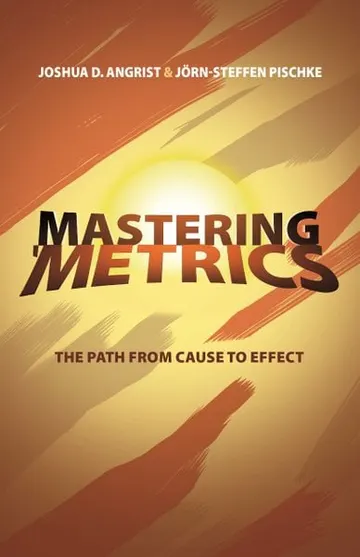
Mastering 'Metrics (opens Bookshop.org)
Joshua D. Angrist and Jorn-Steffen Pischke · 2014
Angrist and Pischke explain regression discontinuity with cutoffs such as the legal drinking age and exam-school admission scores, comparing people just on either side of the line.
Read the news better, every morning.
We send you the day's real progress in science, medicine and beyond, told plainly and sourced. Free, forever.
Free forever, no spam. One click to unsubscribe, and we never sell your email.